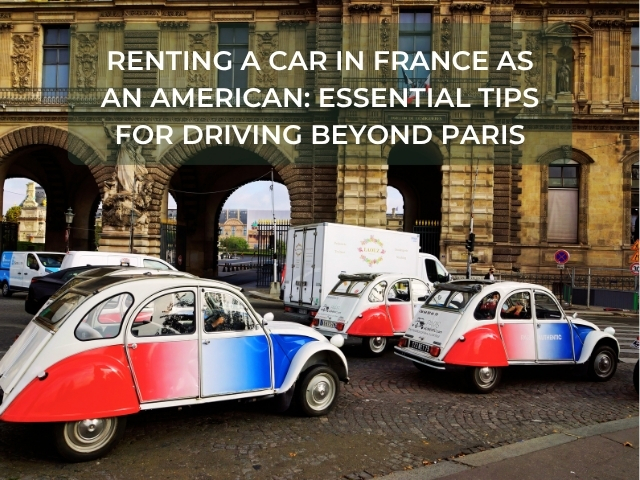
“The freedom to move, to travel, to endeavor.” – Renault Group
France has been drawing American travelers across the Atlantic for generations, and the relationship continues to grow. Approximately 5.5 million Americans visited France in 2025, an increase of 10% over the previous year. American travelers generated €7.3 billion in tourism receipts, while France welcomed 102 million international visitors overall, retaining its position as the world’s most visited country.
For an American arriving in France, the scale of the country can take a little getting used to. Paris, Lyon, Bordeaux, Nice and Strasbourg may look close together on a map, yet each opens onto a distinctly different landscape and culture: vineyards and limestone villages in the southwest, the pale stone and lavender country of Provence, Atlantic fishing ports, Alpine foothills and the Mediterranean coast.
After more than 40,000 miles on European roads, we’ve learned to pay attention to those changes as we drive. Plane trees shade long stretches of pavement, tractors head home from the sunflower fields at dusk, and roadside markets appear with crates of peaches, mesclun and whatever else is being harvested that week. A car gives you the range to experience those shifts firsthand, including the stretches of France that never make it onto a typical first-time itinerary.
For Americans planning a longer French vacances, the flexibility of a car lease can be particularly valuable.
Where to Pick Up Your Car in France: Paris, Nice, and Regional Hubs
Paris will be the arrival point for many Americans, and it deserves the time it commands. Spend several days there on foot and by Métro, walking along the Seine at dusk, lingering over lunch in Saint-Germain or crossing town for dinner. A car becomes far more useful once the city gives way to the countryside, where France stretches into vineyards, coastal roads, mountain valleys and small towns that are difficult to connect by rail.
That is where the choice of pickup location becomes useful. Renault Eurodrive’s current French and Geneva network includes Bordeaux Mérignac, Brest Guipavas, Geneva Cointrin, Lyon Saint Exupéry, Marseille Provence, Montpellier Méditerranée, Nantes Atlantique, Nice Côte d’Azur, Paris Charles de Gaulle, Paris Orly, Strasbourg, Toulouse Blagnac and Calais (see details below regarding the Port of Calais) . Renault also has additional delivery centers elsewhere in Europe.
For an American flying into Paris, the simplest option may be to stay in the capital first and collect the car at Charles de Gaulle or Orly when it is time to leave. There is little reason to navigate Paris traffic or pay for parking while spending your days visiting museums, sitting at café terraces and wandering from one neighborhood to another. Pick up your brand-new Renault when it is time to explore beyond the City of Love and Light.
Alternatively, flying into Nice puts the Mediterranean at the beginning of the trip. Bordeaux brings the vineyards and Atlantic southwest into the picture; Lyon opens the Rhône Valley, Burgundy and the Alps; Strasbourg introduces Alsace and eastern France. Montpellier and Toulouse offer two very different gateways into southern France.
The same flexibility works at the end of a trip. After several weeks on the road, returning the car at a Paris airport allows the final days to unfold in the capital without the responsibility of parking and navigating this bustling city while sightseeing.
Free One-Way Car Rentals in France: Expanding Your Travel Itinerary
For us, this is one of the most useful parts of Renault Eurodrive that has changed the way we travel.
One-way travel within France is included at no charge. A traveler can pick up the vehicle in one French location and return it at another, avoiding the need to build the vacation around a round trip. Renault currently allows the return center to be changed up to four days before drop-off, subject to its terms.
That matters most when the geography of the trip naturally moves in one direction. Someone who begins in Paris and spends the following weeks heading south can return the car in Nice rather than driving north again. A traveler starting on the Mediterranean can make the opposite choice and finish in Paris.
The same principle applies across France. Beginning in Lyon and finishing in Marseille avoids retracing the same roads. A journey from Bordeaux toward Nantes keeps the focus on western France, while Strasbourg to Paris allows a trip through eastern France to finish in the capital.
Renault Eurodrive also operates delivery and return centers elsewhere in Europe, with pricing dependent on the locations involved. For travelers combining France with a broader European vacation, that creates additional possibilities beyond the complimentary French network.
French Alps & Lake Geneva: Picking Up Your Car at Geneva Airport (Ornex)
Geneva Cointrin offers a different starting point for travelers who want mountains at the beginning of their French vacation. The Renault Eurodrive delivery center is located on the French side of Geneva Airport in Ornex, placing the French Alps within easy reach.
Annecy is about 45 minutes away, while Chamonix and Mont Blanc are just over an hour from the delivery center. From the mountains, the road can continue toward the Rhône Valley, eastern France, or south toward Provence.
Geneva also works particularly well for travelers combining France and Switzerland. The lake, Alpine resorts, and French countryside are all close enough to make a multi-country vacation feel geographically coherent rather than divided into separate trips.
Combining France and the UK: The Calais Ferry Connection Strategy
Calais can be useful for travelers combining a French vacation with time in Britain. Renault Eurodrive has a delivery center at the Calais ferry terminals, making it a practical location for beginning or ending the French portion of a northern France trip.
There is one important rule to keep in mind: the Eurodrive vehicle cannot be taken into the United Kingdom. The UK is outside the countries covered by the Eurodrive contract, so the best approach is to treat France and Britain as two separate parts of the vacation. Return the Renault in France, then cross the Channel independently by Eurostar or ferry, or begin your holiday in the UK and cross to Calais, pick up your brand-new vehicle, and continue your European continental exploration.
For travelers who want both countries in the same trip, that keeps the Eurodrive portion straightforward while still making it easy to add London, southern England, or Scotland before or after France.
Driving Rules in France for Americans: Tolls, ZTLs, and Road Laws
French roads are straightforward once you know a few differences. France drives on the right, but keep an eye out for priorité à droite, priority to the right, at intersections where no stop, yield, traffic light, or priority-road sign tells you otherwise. On motorways, move back to the right after overtaking rather than cruising in the middle lane. Give cyclists plenty of room when passing. French rules call for at least give cyclists plenty of room when passing French rules call for at least three feet in built-up areas and five feet outside them and expect motorcycles to filter between lanes in slow or stopped traffic under France’s current lane-filtering rules. Speed limits also change with conditions: the standard motorway limit is 130 km/h (78 mph) in normal conditions and 110 km/h (66 mph)in rain.
Many major autoroutes are toll roads; Visa and Mastercard are generally accepted, while a télépéage electronic toll badge can make repeated motorway travel more convenient. City driving deserves extra attention. Renault Eurodrive clients have Crit’Air Sticker Exemption meaning vehicles registered under the Tax-Free Lease (TT) program are brand-new vehicles and are fully exempt from the Crit’Air sticker requirement in Low-Emission Zones (ZFE)! An agreement was established with the French government to exempt TT vehicles, meaning Renault Eurodrive customers do not need to order or display a sticker while driving in France. This is a very strong advantage that we appreciate with this program.
Some cities also have traffic-restricted areas. Paris, for example, has a Zone à Trafic Limité (ZTL) in the center where through traffic is restricted, so don’t assume that a road shown on your GPS is necessarily a road you can simply drive through. Many ZTLs are camera-ticketed, and you won’t know until you return home just how many tickets you have received, so diligence is very important, and it sometimes helps to put “avoid tolls” on your maps app, but this is not a foolproof plan for ZTLs.
Check the local rules before entering a major city, particularly if you’re heading into a historic center. We know from experience (and too many tickets to count) how important this is to your vacation.
Why a Renault Eurodrive Lease is the Smartest Choice for France
Five and a half million Americans traveled to France in 2025, and that number is still climbing as 2026 marches on.
Many will come for Paris, while others will arrive with a particular château, coastline, vineyard or village in mind. After picking up our Renault Eurodrive cars in Nice, Calais, Paris and Geneva over the years, we have found that the most lasting memories often come from having enough freedom to let France interrupt the plan.
That is how France became a part of our family’s story. It was all the moments in between that became something so much greater than the destination, and it would not have been possible without the flexibility of Renault Eurodrive.
From the earliest days of the Renault Brothers, who founded the brand in 1899, there is something special about driving a Renault on French roads. As cited in early documentation of the brand’s history, “voitures à vivre,” or cars for living, was a central theme, captured by this quote in the opening of this article, which sounds that much better in French:
“La liberté de se déplacer, de voyager, d’entreprendre.”
For questions, contact Renault Eurodrive, and you can also ask us questions anytime.
About the Authors
Ron and Colleen Mariotti are the founders of Livology, a platform dedicated to the art of intentional “Slow Travel.” Since 2013, the family has navigated more than a decade of life on the road with their family of five, crossing dozens of borders and logging tens of thousands of miles across Europe. As dual Italian/American citizens, they bridge the gap between North American travel expectations and the reality of European logistics, serving as trusted guides for travelers seeking depth, culture, and seamless exploration.